Hims & Hers Health surged roughly 40% following a landmark partnership announcement with Novo Nordisk — a deal that potentially settles major litigation and adds branded Wegovy to the HIMS platform, offsetting a prior monthly decline of over 30%. Analysts are projecting 2026 revenue between $2.7 billion and $2.9 billion. The relationship between HIMS and Novo Nordisk has been turbulent, to put it mildly. So is HIMS stock a buy after the restoration of this partnership? Let's break it down.
HIMS vs. Novo Nordisk: Why This Partnership Matters
Both companies benefit from this renewed relationship. HIMS gets to sell Novo's weight-loss drug and bring in new users, while Novo gains access to a much larger patient base through Hims' tech-savvy platform.
Novo Nordisk (NVO) stock has been declining since 2024, largely due to intensifying competition in the weight-loss category — Eli Lilly's Zepbound/Mounjaro has shown better clinical weight-loss results — plus political pressure in the U.S. to lower prices that were significantly higher than in Europe. Novo's stock price had also been propped up by a supply shortage, with demand outpacing what the company could actually manufacture. Partnering with HIMS gives Novo a faster path to more customers and more sales.
The GLP-1 Shortage Timeline: How the Legal Feud Started
The surge in popularity of Ozempic and Wegovy in 2022 and 2023 was so massive that Novo Nordisk simply couldn't manufacture enough pens to keep up.
Once the shortage officially ended, HIMS tried to stay in the compounding game with a different legal argument: personalization. By adding ingredients like Vitamin B12 or adjusting dosages, HIMS claimed it wasn't making "copies" but "personalized medications" — a separate legal protection. Big Pharma and the FDA didn't buy it, arguing these were "pretextual differences" designed to bypass patents. That disagreement led directly to FDA warning letters and the Novo Nordisk lawsuit that ultimately forced HIMS to cancel its compounded pill launch.
The Surprise Truce: Inside the March 2026 Settlement
Just weeks after HIMS stock bottomed out near $13, the story flipped entirely.
HIMS Financials: Revenue, Profit, and Growth Rates
You can research HIMS stock and see this entire volatile history for yourself on youdomo.com. HIMS is basically flat since 2024, going from a high of $68 per share to $22 per share. That massive sell-off driven by legal uncertainty could serve as a buying opportunity, especially now that there's some light at the end of the tunnel.
Start with the top-line fundamentals: revenue, gross profit, and net income are all trending up, a good signal for a growing company. HIMS became net income positive in 2024 — a major milestone that shows proven profitability alongside continued growth.
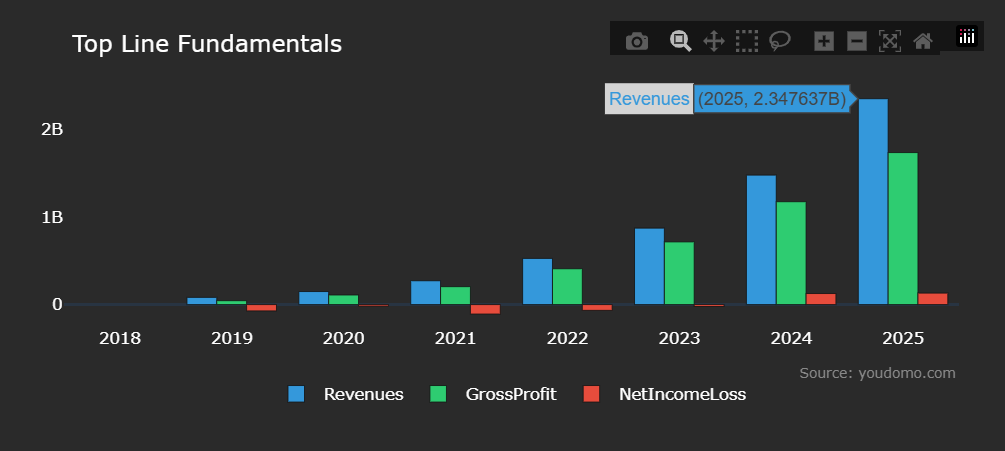
HIMS is also growing these line items quickly. Revenue grew 58% year-over-year — dramatically faster than the Household and Personal Products industry average.
The $1.15 Billion Eucalyptus Acquisition and Rising Debt
Next, look at the balance sheet: cash, assets, and current and total liabilities. The standout is HIMS' Debt-to-Equity ratio, which spiked dramatically past 200% in 2025 as the company leaned more heavily on debt to fund its expansion.
The single largest driver of that debt spike is the acquisition of Eucalyptus, an Australian telehealth giant, announced in February 2026. HIMS agreed to a $1.15 billion deal to enter the Australian and Japanese markets. While $240 million was paid upfront in cash, the remaining $700 million-plus is structured as "guaranteed deferred payments" and "earnout" liabilities — obligations that get categorized as long-term debt on the balance sheet, immediately skewing the D/E ratio upward.
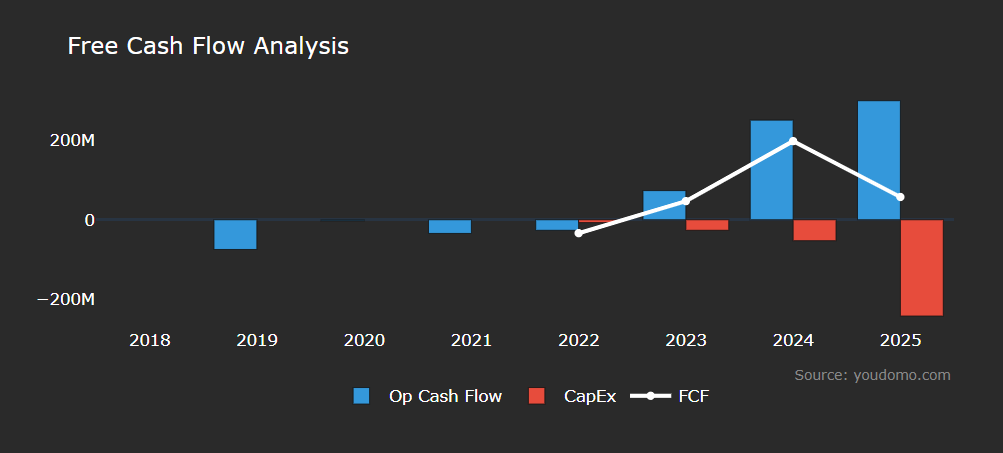
On top of that, HIMS spent over $226 million on capital expenditures throughout 2025, buying its own pharmacy facilities and high-end compounding equipment instead of renting space and relying on third-party suppliers. Much of that was financed through equipment leases and long-term debt, preserving cash for the Eucalyptus deal.
HIMS is in a tech-growth phase and needs to sustain high growth rates to cement itself as a major player in the medical industry. It's a similar disruption story to Robinhood or SoFi — technology-oriented companies disrupting clunky, non-transparent legacy industries. The good news: the debt load is overwhelmingly long-term, with the JPMorgan facility and Eucalyptus payments spread out through 2029, which should prevent a short-term liquidity crunch.
The HIMS Moat Strategy: Vertical Integration and Diversification
HIMS' free cash flow has historically been choppy, turning positive in 2023. Keeping it that way is largely a function of vertical integration and diversification away from GLP-1s — the FDA-approved medications that mimic a hormone regulating blood sugar, slowing digestion, and reducing appetite.
Building the Moat In-House
HIMS is aggressively bringing fulfillment in-house — building its own pharmacies and using proprietary software to manage prescriptions, cutting out middleman fees. In 2025, gross margin slipped from 79% to 74%, but controlling the supply chain helps protect remaining margins even as HIMS lowers prices to compete with Amazon and Eli Lilly. The company is also optimizing "shipping cadences" — how often refills go out — to reduce logistics costs, which had been a meaningful drag on cash in late 2025.
Diversification Away from GLP-1s
A major risk to HIMS' cash flow has been its heavy reliance on compounded semaglutide. To keep cash flowing regardless of what the FDA or Novo Nordisk does next, HIMS is scaling non-GLP-1 "Power Brands":
- The $100M Club: Sexual Health, Men's Dermatology, Women's Dermatology, and oral Weight Loss each now generate over $100 million in annual revenue.
- The Hers Pivot: The "Hers" brand is approaching $1 billion in revenue on its own, driven by high-margin, long-term subscriptions for menopause and hair care.
GLP-1s aren't the end game for HIMS, but the Novo Nordisk truce removes the legal risk that had been weighing on the stock, potentially clearing the way for a real run higher. The long game for HIMS is becoming the aggregator of health.
Hims Labs: Monetizing Longevity via Diagnostics
The launch of Hims Labs is a key free cash flow driver going forward. Subscription pills are "low-touch" — blood testing is "high-touch." By getting users to pay for regular lab tests across 130-plus biomarkers, HIMS increases the lifetime value (LTV) of each customer without significantly increasing acquisition cost. Lab data also enables predictive, cross-sell revenue: a hair-loss patient who discovers high cholesterol through testing might start a statin subscription, increasing revenue per user without a new acquisition cost.
HIMS Valuation: Trading at a Discount to Its Own History
With the financials covered, it's time to look at valuation. YouDomo calculates popular valuation ratios — price-to-sales, price-to-earnings, and price-to-free-cash-flow — automatically, making this kind of comparison fast. HIMS is currently trading at a discount to its own historic self. In fact, HIMS is trading at its lowest price-to-sales ratio in company history. The last time HIMS traded below its historical average, in 2023, the stock ran from $6 a share to $68.
You can also compare growth rates and valuation ratios directly against industry averages. HIMS' most recent year-over-year gross profit growth was 47%, while the industry average was just 3%. The industry is contracting while HIMS is expanding its profits — not exactly the profile of a stock that should be trading downward long term.
The goal is always to find stocks growing their fundamentals while trading at a discount. Right now, HIMS' price-to-sales ratio has drifted back down near the industry average — even though HIMS is growing significantly faster than that industry. Why would a faster-growing company trade in line with slower peers? Because of the legal risk from the Novo Nordisk feud, which introduced real fear into the stock. The renewed partnership should help close that gap and support HIMS' share price from here.
Final Verdict: Is HIMS Stock a Buy or Sell in 2026?
Long term, HIMS looks like a good stock to own for investors who can stomach turbulence. Think of HIMS as an aggregator play in health, similar to how Zillow gatekeeps housing information, Robinhood gatekeeps retail investing, or SoFi gatekeeps student loans and banking products. HIMS is positioning itself as the gatekeeper of your personal health data — lab results, prescriptions, and eventually wearable data from devices like Apple Watch or Garmin — and being that central data layer is valuable infrastructure the current medical system simply doesn't have. The Novo Nordisk settlement removes a major legal overhang, fundamentals are growing well ahead of the industry, and the valuation is near historic lows. The risk is real volatility and ongoing regulatory uncertainty in the compounded-drug space.
This article is for information and education only and is not financial advice. Do your own research, or consult a licensed financial advisor, before making investment decisions. Past performance does not guarantee future results.